
Pathology review
Review archive age, location, tumor content and fixation history; define the region of interest.
ARC-WELL · CELL 2023
Connect archived tissue to disease progression through single-cell DNA copy-number profiles.
THE RESEARCH OPPORTUNITY
Histology, treatment records and follow-up establish a retrospective study. Arc-well adds single-cell DNA copy-number evidence.
Study figures from Cell 2023 and the supplied materials; not a success-rate guarantee for specimens of any archive age.
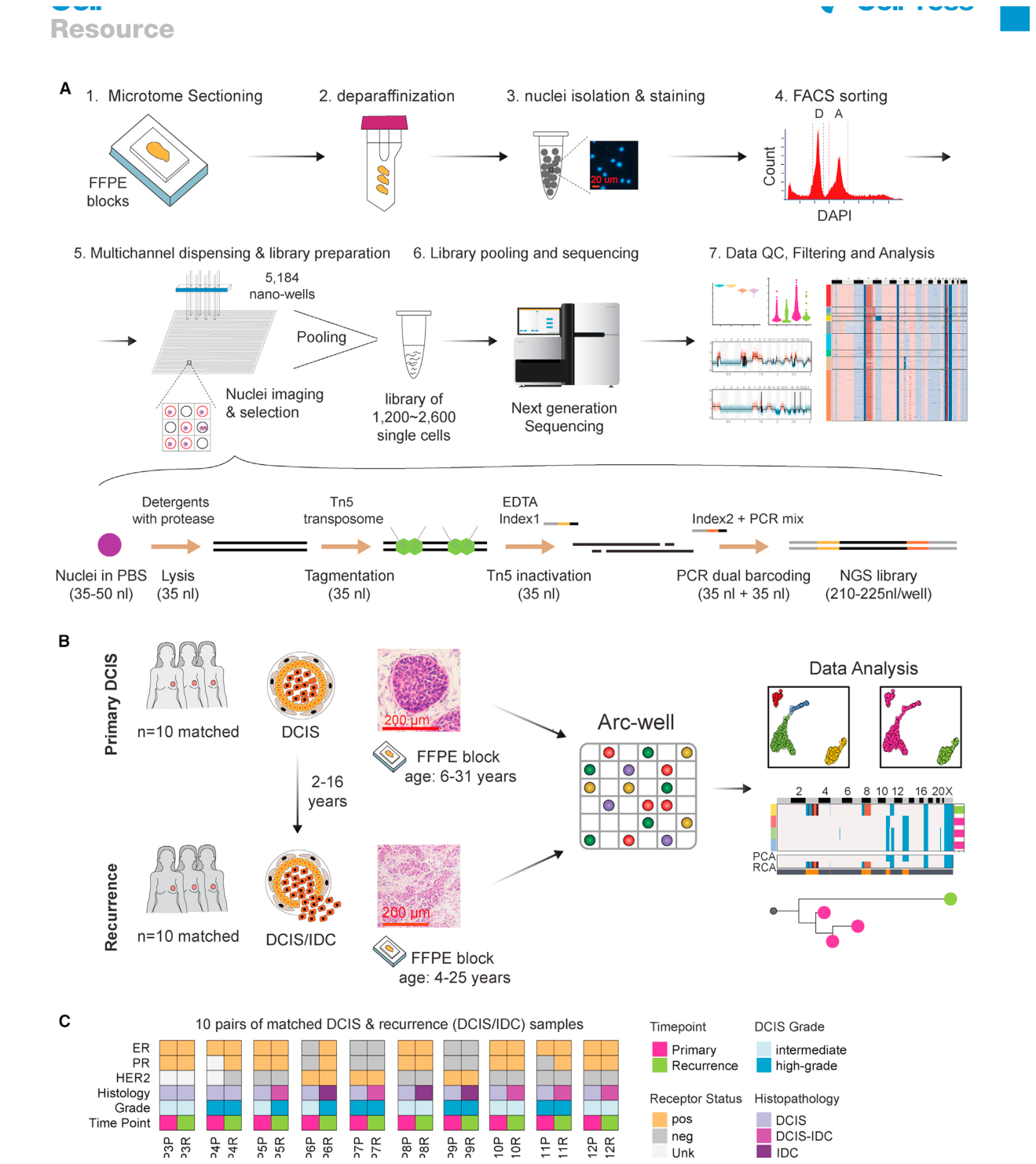
FROM BLOCK TO CLONE
Review archive age, location, tumor content and fixation history; define the region of interest.
Deparaffinization, nucleus preparation and selection precede nanowell dispensing and single-nucleus imaging.
Track cell output, libraries and sequencing quality; determine analyzable data from sample-level QC.
Compare single-cell CNAs, reconstruct candidate subclones and evolutionary relationships, then interpret them with the clinical timeline.
Open figure ↗WHAT THE DATA CAN TELL YOU
Organize interpretable, reviewable results that can inform further validation.
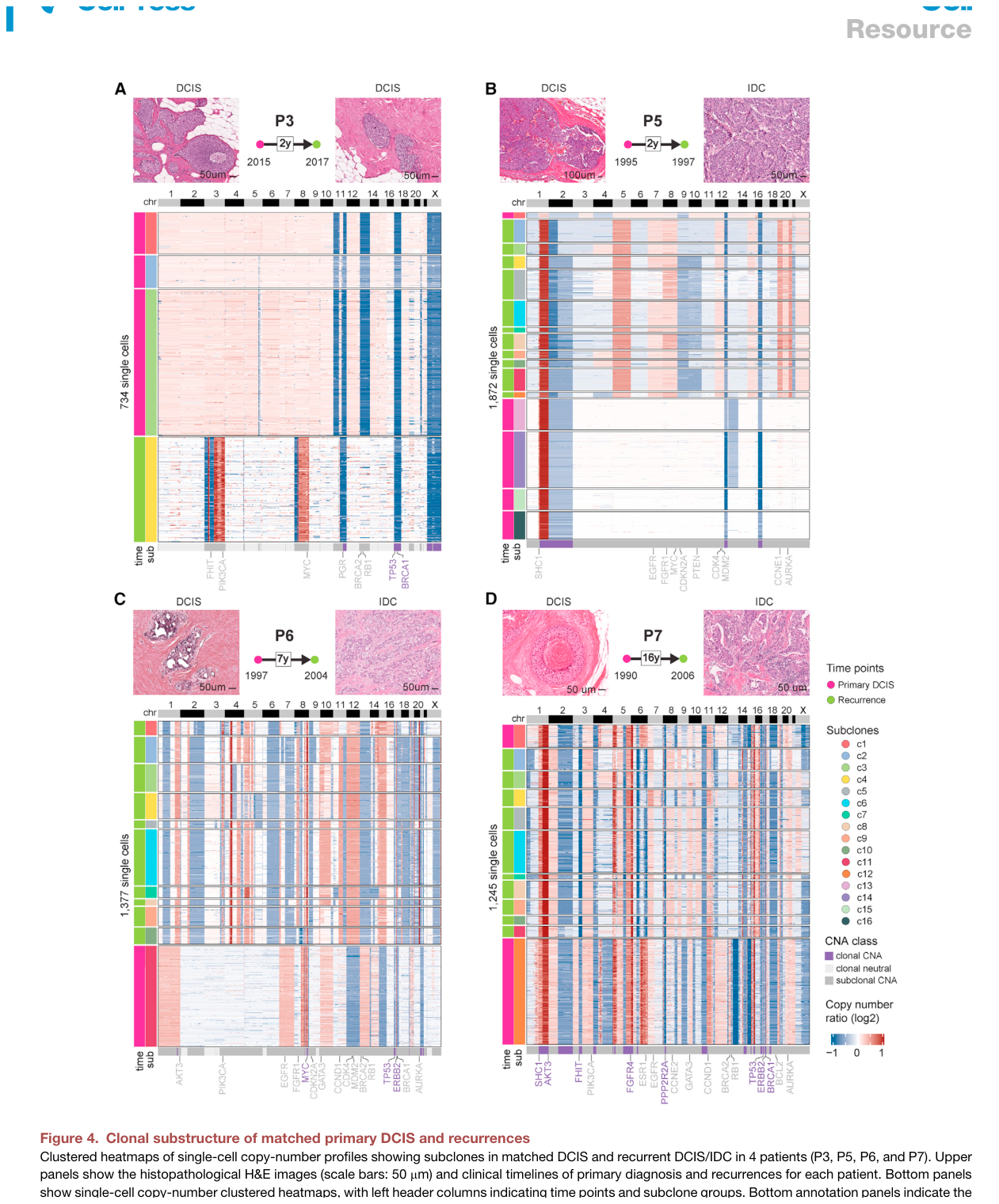
Examine chromosomal gains, losses and copy-number patterns at cell resolution.
Analyze clone fractions, shared events and divergence with explicit modeling assumptions.
Investigate persistence, bottlenecks and additional events with clinical timelines and testable hypotheses.
 Open figure ↗
PUBLISHED STUDY
In the ductal carcinoma in situ (DCIS) progression study, paired samples link pathology, clinical time and CNA structure to investigate persistent subclones and subsequent evolution.
A clonal tree is reconstructed from DNA measurements and modeling; it is not direct lineage tracing of every cell. Other tumor types require new sample and study assessment.
Read the evidence and sourceBEFORE YOU START
Archive age alone is not enough. Tissue amount, tumor fraction, fixation, storage, necrosis and nuclear integrity need assessment. Unconfirmed universal acceptance thresholds are not published here.
This workflow centers on single-cell CNA and clonal analysis. It does not promise comprehensive SNV/indel, fusion or structural-variant detection; those questions need additional assays.
Discuss 3–5 specimens for feasibility or 3–5 matched pairs for an evolutionary question. A pilot is not a statistically powered definitive cohort.
Use FISH, ddPCR or appropriate DNA assays for key copy-number events. IHC assesses protein expression and localization, not DNA copy number directly.
QUALITY BEFORE SCALE
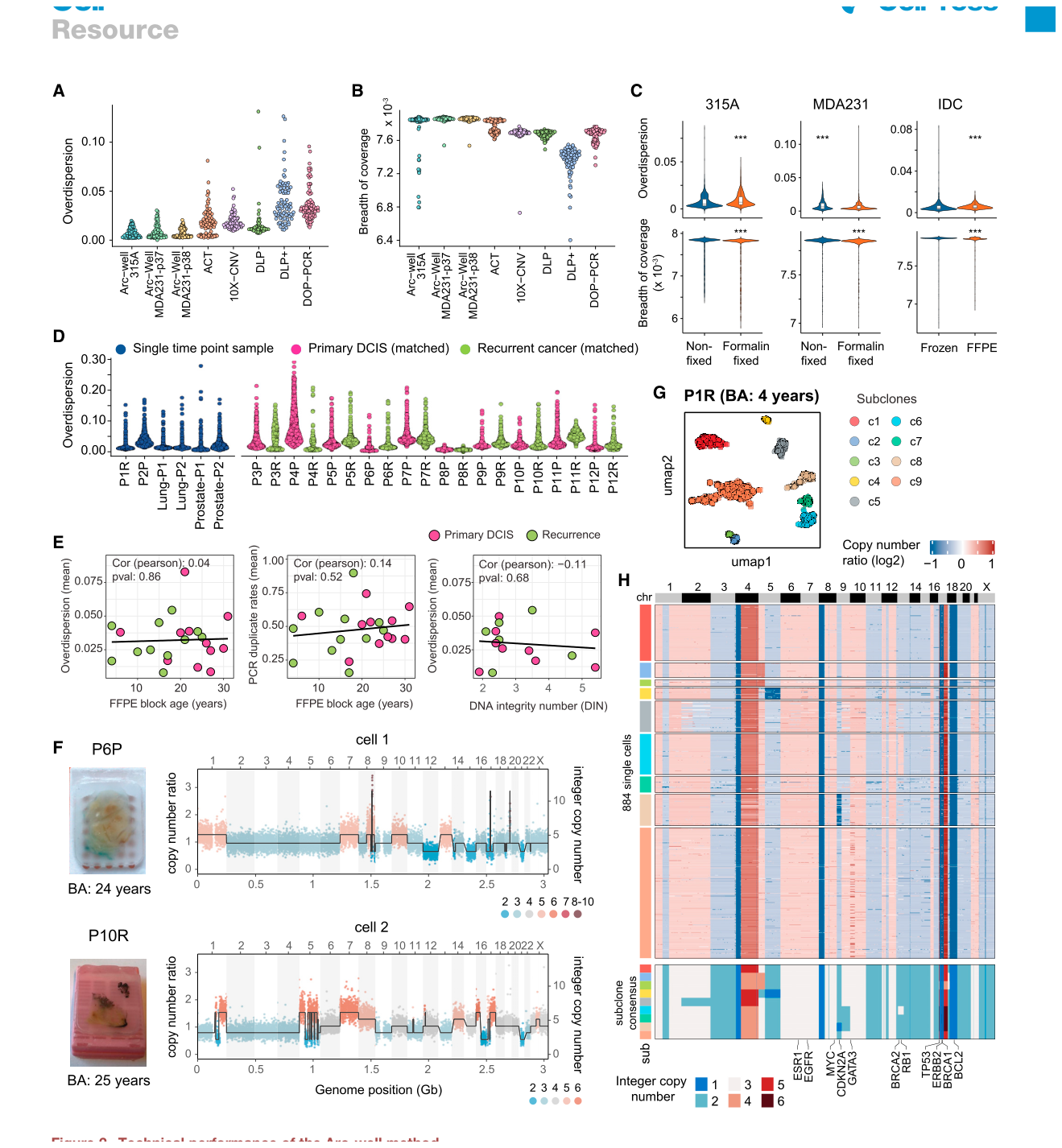
The Cell 2023 technical assessment uses fixed and unfixed material, archived specimens and single-cell CNA profiles to evaluate data quality in FFPE conditions.
Review material condition, nuclear integrity, effective cell output and potential doublets.
Review usable reads, coverage, noise and interpretability of CNA profiles.
Use controls, batch records and appropriate DNA-level assays to evaluate robustness.
Published method metrics inform understanding; they do not replace the acceptance criteria agreed for your specimens.
 Open figure ↗
LET’S BUILD YOUR STUDY
Bring your sample type, research question and existing data. Let’s find the right starting point.