
Origin & ancestral clones
Combine genomic relationships and normal epithelial lineage signals to formulate—not prove—cell-of-origin hypotheses.
WELLDR-SEQ · CELL 2025
Paired DNA and RNA measurements in assessed fresh tissue provide cell-level evidence for clone–phenotype relationships.
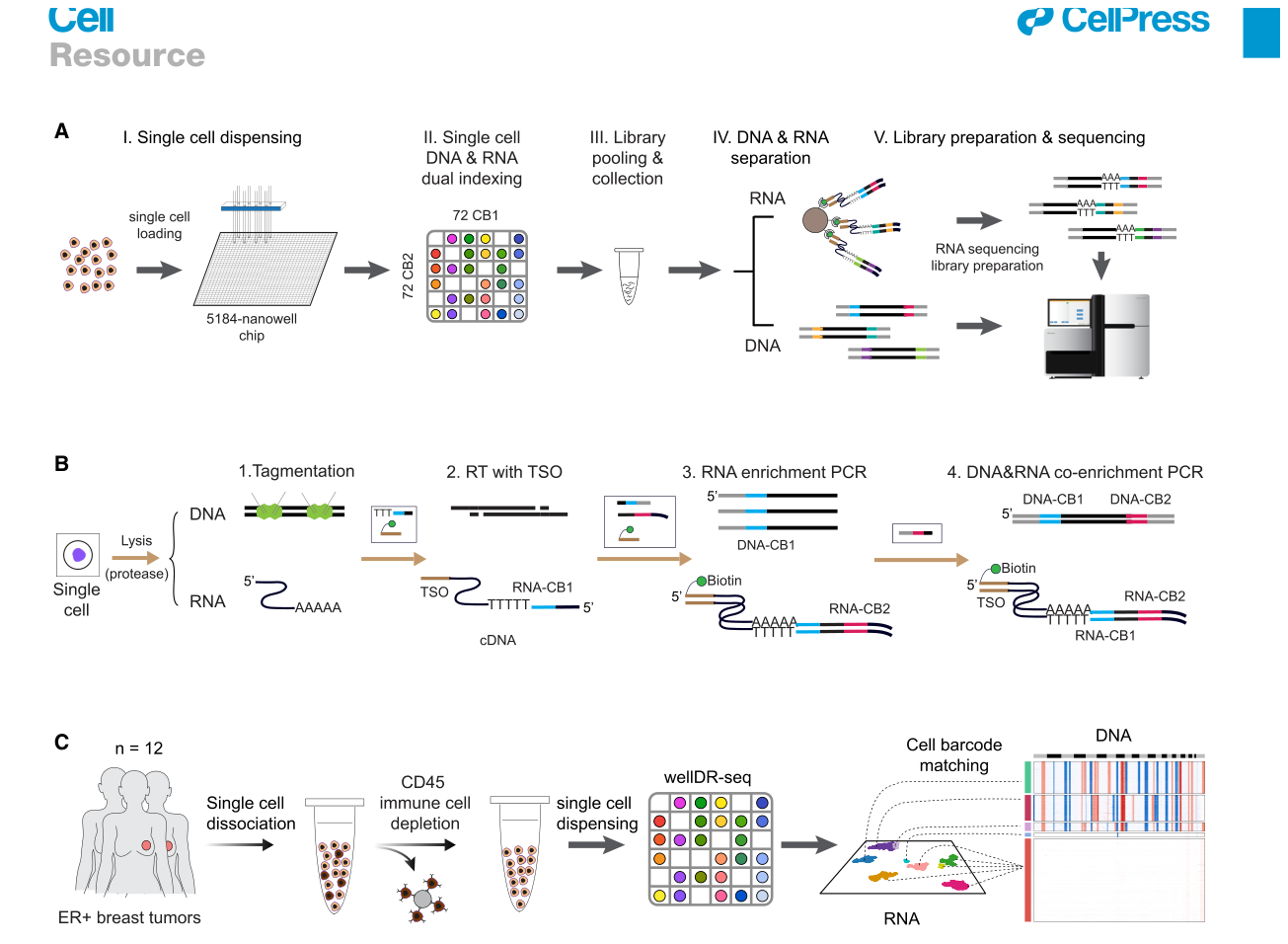
SAME CELL. TWO MOLECULAR READOUTS.
RNA describes state; DNA provides copy-number and clonal evidence. Directly paired measurements preserve their cell-level correspondence.
These describe the Cell 2025 study, not pan-cancer validation or per-project cell-yield guarantees.
Open figure ↗THE PAIRED WORKFLOW
DNA and RNA are separately barcoded in the nanowell workflow, preserving same-cell identity. Analysis centers on genome-wide low-pass CNA and transcriptional readouts.
Copy-number structure
Genomic subclones
Expression programs
Cell states
Clone–phenotype relationships
Dosage associations
QUESTIONS WORTH GOING DEEPER
Not every expression difference follows a copy-number change. Define subclones first, then examine states and candidate mechanisms.
Combine genomic relationships and normal epithelial lineage signals to formulate—not prove—cell-of-origin hypotheses.
Compare copy number and expression within paired cells and subclones to prioritize candidates for functional validation.
With appropriate pairs and controls, explore the contributions of clonal selection and transcriptional plasticity.
PUBLISHED STUDY · GENE DOSAGE
The supplied Cell 2025 materials report near-linear expression associations for about 56% of CNA segments in that study. This illustrates paired analysis—not a universal dosage effect for every gene.
Follow-up may include genetic perturbation, organoid experiments or independent cohorts. Same-cell association alone does not replace causal experiments.
Read the research interpretation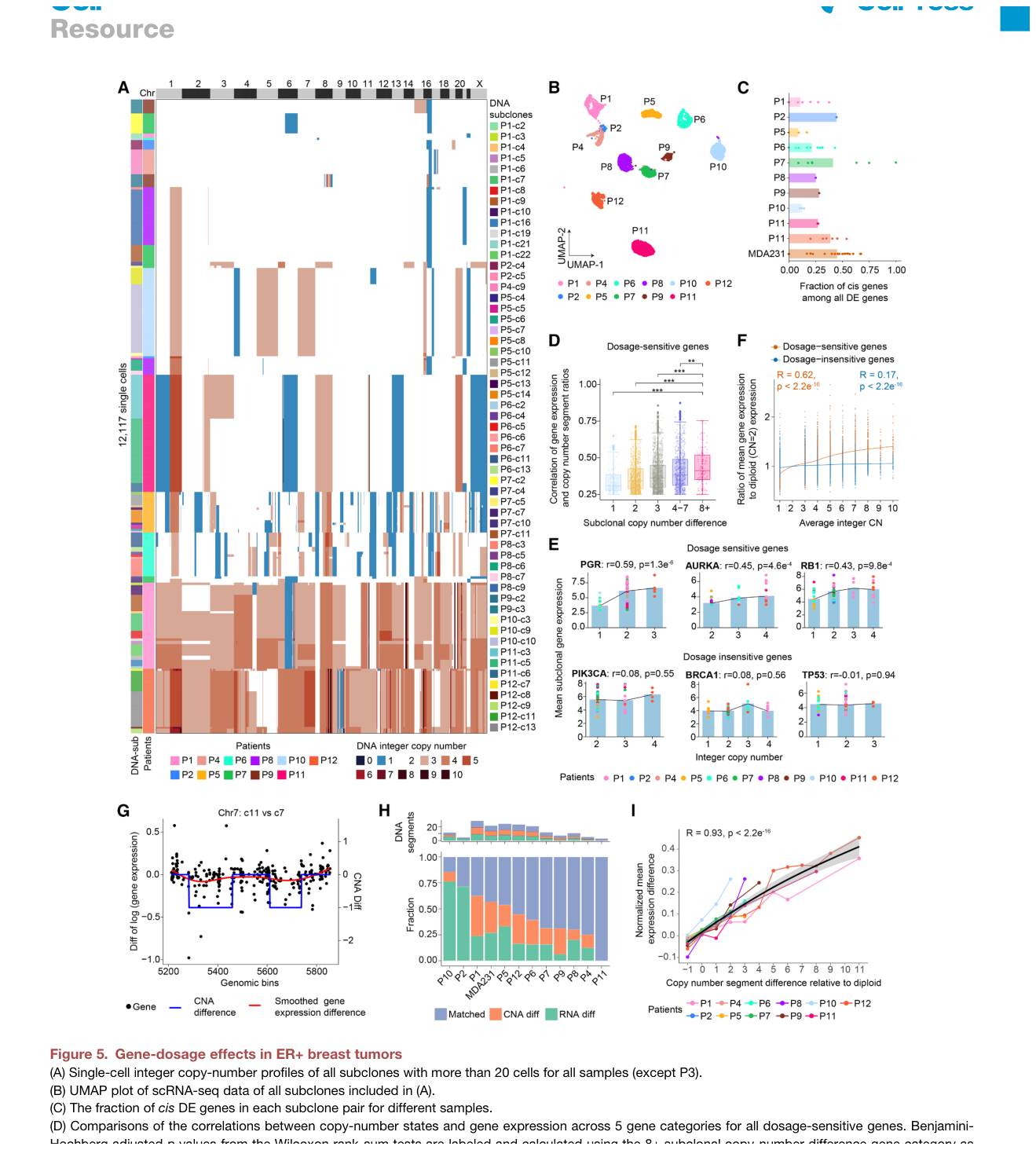 Open figure ↗
SAMPLE & DESIGN NOTES
This page is based on the published fresh solid-tumor study. Other preservation methods and tissue types require assessment; archived FFPE is not assumed compatible with this DNA+RNA workflow.
Discuss additional DNA evidence and validation. Old scRNA and newly measured DNA from different cells remain cross-sample or cross-cell integration, not directly measured same-cell data.
No. Rare-clone observation depends on effective cell count, background, quality and thresholds. Mechanistic candidates require independent validation.
LET’S BUILD YOUR STUDY
Bring your sample type, research question and existing data. Let’s find the right starting point.